
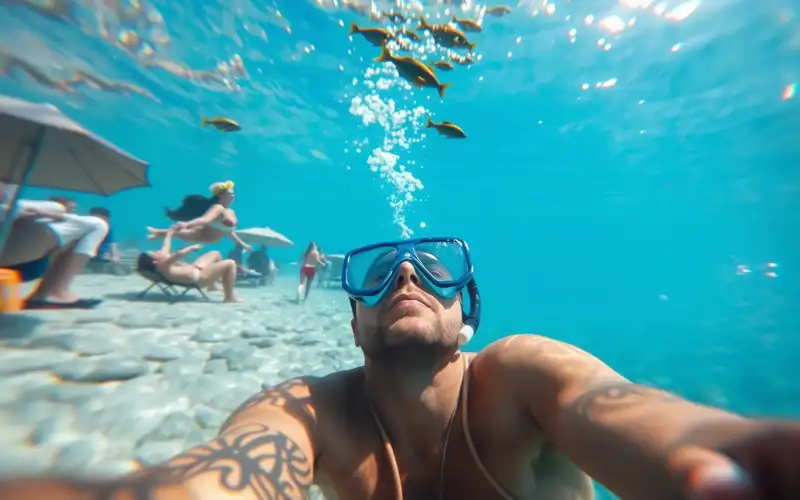
Last September, I watched a group of four divers descend into the blue off Mackenzie Beach and vanish within seconds—not into danger, but into the controlled chaos of a drift dive. The current that day was running at 1.2 knots, enough to carry them south along the rocky shelf while they photographed grouper and octopus without fighting the water. That's drift diving in Larnaca: surrender to the current, trust your buoyancy, and let the sea do the work.
Drift diving is not a beginner's game. It demands respect for underwater currents, meticulous planning, and operators who understand local conditions intimately. Around Larnaca and the south Cyprus coast, drift diving has evolved from a niche pursuit into a structured discipline, with seasonal windows, mapped entry and exit points, and a growing number of dive shops offering dedicated technical services. This guide unpacks what makes drift diving work here, why certain months are better than others, and how to book safely with operators who run these dives by protocol.
Understanding Cyprus Drift Currents: The Science Behind the Flow
Cyprus sits at a crossroads of Mediterranean current systems. The Atlantic Water Mass—warm, low-salinity water flowing east from the Atlantic through the Strait of Gibraltar—meets the Eastern Mediterranean Deep Water in the waters south of the island. Along the south coast, where Larnaca sits, the dominant influence is the Cyprus Coastal Current, a seasonal feature that strengthens in summer and weakens in winter.
This current typically runs east to west along the Larnaca shoreline, accelerating where the continental shelf narrows. Between May and September, water temperatures climb to 26–28°C, and current speeds often range from 0.5 to 1.5 knots. In winter (November to March), temperatures drop to 16–18°C, currents weaken, and visibility—already variable—becomes less predictable. The real magic happens in the shoulder months: April, May, and October, when currents are moderate, temperatures comfortable, and visibility often exceeds 25 metres.
Local dive operators track these patterns obsessively. Most maintain current logs dating back years, recording speed, direction, and visibility for every site. This data is not academic—it directly informs whether a drift dive is feasible on any given day. A 0.8-knot current with a clear entry and exit point is ideal. A 2-knot current in choppy conditions with poor surface support is a cancellation.
Seasonal Patterns and Monthly Breakdown
Winter (November to March) sees the weakest currents but also the poorest visibility. Average current speeds drop below 0.5 knots, making traditional drift diving less rewarding. However, the reduced flow means calmer conditions for learning or refining technique in shallower water. Water temperature hovers around 16–17°C, requiring a 5mm wetsuit or thicker.
Spring (April to May) marks the drift diver's sweet spot. Currents strengthen to 0.8–1.2 knots, water clarity improves to 20–30 metres, and temperatures climb to 20–23°C. Operators report high booking rates for drift excursions during this window. The Zenobia wreck, lying at 42 metres off Vasilikos, becomes a prime drift target when currents are favourable.
Summer (June to September) brings the strongest currents—often 1.2–1.8 knots—and warmest water (26–28°C). Visibility remains good, though occasional algal blooms can reduce it. Many operators run daily drift dives in July and August, but the intensity of the current demands experience. Inexperienced divers should avoid summer dives unless they've logged significant drift experience elsewhere.
Autumn (October) mirrors spring: moderate currents (0.8–1.0 knots), excellent visibility (25–28 metres), and water temperatures around 24–25°C. October is often overlooked by holiday divers, yet many local operators consider it the finest month for drift diving. Fewer tourists mean smaller groups and more attention to safety protocols.
Larnaca's Prime Drift Diving Sites and Entry Points
Drift diving in Larnaca's waters is not a free-for-all. Specific sites have been mapped, tested, and refined over years. Each has distinct current behaviour, depth profiles, and hazards.
Mackenzie Reef and the Eastern Approach
Mackenzie Reef lies roughly 1.5 kilometres south-southeast of Mackenzie Beach, at depths ranging from 12 to 28 metres. The reef itself is a rocky outcrop carpeted with soft corals, gorgonians, and home to large grouper and amberjack. Current here typically runs south to north in spring and summer, at speeds of 0.8–1.3 knots. Entry is from the beach or from a boat positioned north of the reef; exit is north, toward shallower water or back to the beach depending on current strength. Visibility averages 22–26 metres. The site suits intermediate to advanced divers with 100+ logged dives.
The entry protocol is strict: divers descend on a line to 18 metres, establish buoyancy, then follow the reef contour while drifting. The current carries them northward; a surface support boat maintains visual contact. Exit is timed to avoid being swept into open water. Most dives last 35–40 minutes at depth.
Vasilikos Point and the Zenobia Wreck Approach
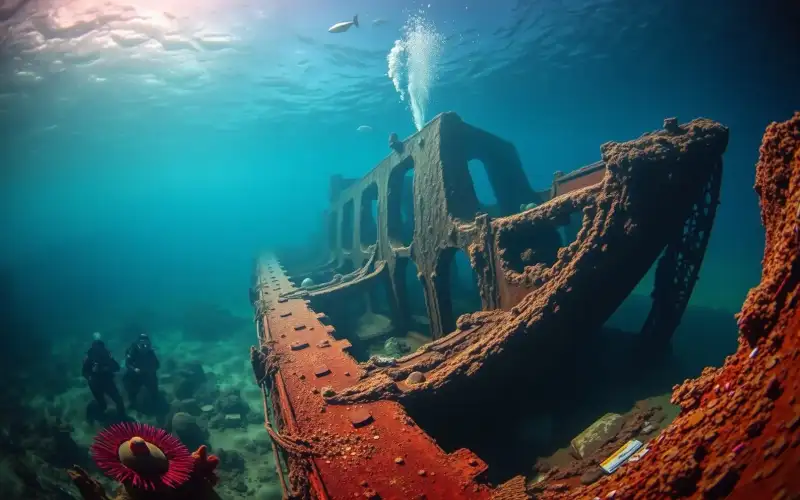
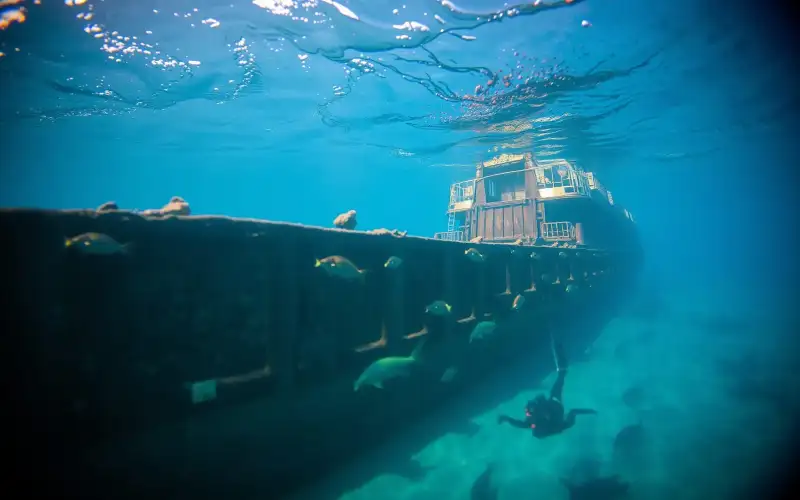
Vasilikos Point, near the village of the same name, is the gateway to Cyprus's most famous wreck: the RMS Zenobia, a Swedish ro-ro cargo ship that sank in 1980 and now rests at 42 metres. Drift diving the Zenobia is an advanced pursuit, restricted to divers with deep and wreck experience, typically 150+ logged dives and current technical training.
The current around Vasilikos runs predominantly east to west in summer, at 1.0–1.6 knots. Divers enter via descent line near the wreck's stern, drift along the hull at 40–42 metres, and exit via ascent line positioned west of the wreck. Bottom time is limited to 20–25 minutes due to depth and decompression requirements. Most operators require nitrox certification and recommend a computer capable of tracking decompression stops. The dive is physically demanding and psychologically intense—the Zenobia's massive steel hull, partially collapsed, creates an otherworldly landscape.
Only three Larnaca operators regularly run Zenobia drift dives: Blue Horizon Diving, Larnaca Dive Centre, and Dive Cyprus. Each requires a pre-dive briefing and a maximum group size of four divers per guide.
Larnaca Breakwater and the Shallow Drift
For divers seeking drift experience without extreme depth, the Larnaca Breakwater offers a gentler introduction. This site, running along the western side of Larnaca's main port, sits at 8–16 metres and experiences currents of 0.3–0.8 knots. The seafloor is sandy with rocky patches; marine life includes small grouper, wrasse, and occasionally cuttlefish. Visibility is moderate, around 12–18 metres. The site is ideal for divers with 50+ logged dives and serves as a training ground for drift technique.
Entry and exit are both from shore, typically near the old fort or the breakwater's northern end. The current carries divers eastward along the breakwater; they maintain a distance of 3–5 metres from the rocks to avoid entanglement. Dives last 40–50 minutes, with shallow depth allowing extended bottom time.
Specialist Equipment and Technical Considerations
Drift diving demands more than a standard recreational kit. The following equipment is either essential or strongly recommended:
- Dual-tank or sidemount configuration: Many advanced divers use twin 7-litre tanks or a sidemount setup to extend bottom time and manage decompression obligations. Single-tank dives are possible on shallow sites like the Breakwater but not recommended for Zenobia or deep reef work.
- Dive computer with decompression algorithm: A computer capable of tracking multiple gas mixtures is essential for deeper drifts. Many divers use computers from Shearwater or Garmin, which offer wireless air integration and detailed logs.
- Nitrox or trimix certification: Nitrox (32–36% oxygen) is standard for depths of 30–40 metres, extending bottom time and reducing nitrogen loading. Trimix is used for the Zenobia and other deep technical dives.
- Stage bottles or bailout bottles: On technical dives, carrying a small bailout bottle (2–3 litres) at 6 metres provides a safety margin. This requires additional training and buoyancy control.
- High-visibility surface marker buoy (SMB): A 1.5–2 metre SMB with a reel is mandatory. It marks your position for surface support and other boat traffic.
- Redundant depth gauge and compass: While a dive computer provides depth, a backup mechanical gauge is prudent. A compass aids navigation in low-visibility conditions.
- Thermal protection: A 5mm or 7mm wetsuit is standard in spring and autumn; a thicker suit or drysuit is advisable in winter. Water temperatures of 16–17°C demand serious thermal management to maintain focus and avoid hypothermia over extended dives.
Total kit cost for a fully equipped technical diver ranges from £2,500 to £5,000, not including training or certification courses.
Current Patterns and Real-Time Data: What Operators Monitor
Professional Larnaca dive operators don't rely on guesswork. They maintain detailed logs and use real-time data sources to make daily dive decisions.
Sources of Current Information
Operators consult several data streams. The Cyprus Meteorological Service provides wind forecasts and sea-state predictions; strong northerly winds often correlate with stronger currents. The European Copernicus Marine Service offers satellite-derived sea surface temperature and current velocity maps, updated every few days. Most importantly, operators maintain personal logs of current observations, updated by divers returning from each excursion. A typical log entry records date, time, depth, current speed (estimated or measured with a flow meter), direction, visibility, water temperature, and notable marine life or hazards.
When currents exceed 1.8 knots or visibility drops below 10 metres, most operators cancel drift dives and offer alternative shallow or shore dives instead. This is not caution—it's protocol. A drift dive in poor conditions is not challenging; it's reckless.
Forecasting and Booking Windows
Larnaca's dive operators typically open bookings 2–4 weeks in advance. For drift dives, they often hold availability until 48 hours before the scheduled date, allowing them to assess weather and current forecasts. If conditions deteriorate, they offer alternative dates or a full refund. This flexibility is essential because Mediterranean conditions can shift rapidly.
In 2026, several operators have introduced WhatsApp groups and email alerts for divers interested in drift excursions. When conditions are favourable—typically spring and autumn—these groups light up with notifications of available slots. Demand is high; booking as soon as a dive is posted often means the difference between joining a group or waiting for the next window.
Certified Operators and 2026 Drift Dive Services
Not every dive shop runs drift dives. The following operators in Larnaca have documented experience, trained guides, and structured protocols for drift diving in 2026:
Blue Horizon Diving
Based near Larnaca Marina, Blue Horizon operates daily drift dives April through October. Their team includes three guides with 500+ logged dives each and technical training from the Technical Diving International (TDI) and IANTD (International Association of Nitrox and Technical Divers). They offer drift dives at Mackenzie Reef (£65 per person, including boat, guide, and weights) and the Zenobia wreck (£95 per person, requiring advanced certification). Small groups—maximum four divers per guide—ensure personalised attention. Their boats are equipped with GPS, radio communication, and oxygen kits. Booking is via their website or by phone; they require proof of certification and a minimum of 50 logged dives for reef dives, 150+ for the Zenobia.
Larnaca Dive Centre
Located in the town centre, Larnaca Dive Centre has been operating since 2001 and is one of the oldest shops on the island. They run drift dives at the Breakwater (£45 per person, suitable for intermediate divers), Mackenzie Reef (£70), and Zenobia (£100). Their guides are PADI and SSI certified with specialisations in deep diving and wreck diving. They operate smaller boats, ideal for intimate groups but less suitable for rough seas. Availability is high in spring and autumn; summer booking can be tight. Prices include equipment rental if needed. They offer a 10% discount for divers booking three or more dives in a week.
Dive Cyprus
The newest operator on the Larnaca roster, Dive Cyprus opened in 2024 and has quickly built a reputation for technical excellence. Their guides include a former commercial diving instructor and a marine biologist. They specialise in Zenobia dives (£110 per person) and run customised drift experiences for groups with specific interests—wreck enthusiasts, photographers, or marine life researchers. Their boats are state-of-the-art, with rebreather support available for technical divers. Booking is competitive; they often fill their Zenobia slots weeks in advance. Prices are higher than competitors, but their attention to safety and customisation appeals to serious technical divers.
Practical Booking Information for 2026
Most operators accept bookings via email or WhatsApp. Payment is typically 50% deposit to confirm, balance due on the day of the dive. Cancellations by the diver forfeit the deposit if made within 7 days of the scheduled date; operator cancellations due to weather or conditions are refunded in full. Dives typically depart at 8:00 or 9:00 AM, with return by early afternoon. Lunch is often available at waterfront tavernas near the dive shops—a tradition I've come to cherish, swapping stories with other divers over fresh fish and local wine.
All operators require divers to complete a liability waiver and provide proof of medical fitness (a signed form is usually sufficient; formal medical clearance is required only for divers over 65 or with pre-existing conditions). Rental equipment is available but limited; bringing your own kit is advisable if you have specific preferences or technical configurations.
Safety Protocols and Risk Mitigation
Drift diving carries inherent risks: depth, current, decompression obligations, and the possibility of separation from the group. Responsible operators mitigate these risks through rigorous protocols.
Pre-dive briefings last 20–30 minutes and cover current conditions, site hazards, entry and exit procedures, emergency signals, and group positioning. Divers are reminded to monitor air consumption and buoyancy continuously. A maximum depth is set, and divers are expected to ascend if they reach 50% of their starting air or if they feel uncomfortable. Surface support is mandatory: a boat positioned to monitor the group visually and to recover divers at the designated exit point. Communication is via hand signals underwater and radio on the surface.
Decompression stops are mandatory on dives deeper than 18 metres. For Zenobia dives at 42 metres, typical stops include 3–5 minutes at 9 metres and 5–10 minutes at 6 metres, depending on bottom time and gas mixture. Computers calculate these automatically, but divers are trained to recognise and respond to computer alarms.
In the event of a diver going missing, protocols activate immediately: the boat maintains position and radios the Larnaca coastguard with GPS coordinates. Divers are trained to surface, deploy their SMB, and remain calm. Most
Comments (0 comments)
No comments yet — be the first!