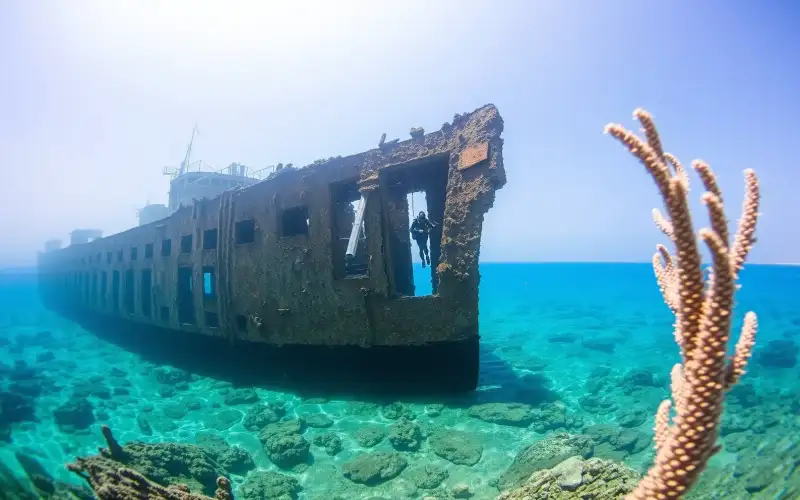
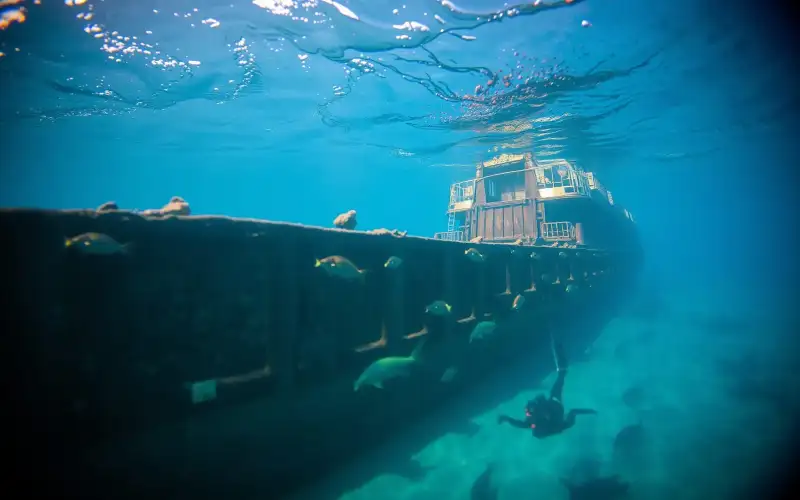
I was 200 metres from the Zenobia's wheelhouse when my dive computer beeped a low-oxygen warning. Forty-two metres below, visibility stretched to 15 metres. The Swedish ferry's cargo hatches hung open like broken ribs, and inside I could make out the ghostly shapes of lorries still parked on her vehicle decks after 46 years underwater. That moment—suspended between the wreck's steel walls, listening to my own breathing echo inside a sunken ship—is why divers travel from across Europe to Larnaca.
The Zenobia isn't just another wreck. She's a time capsule. A fully intact 18,000-tonne ferry that sank within sight of Larnaca harbour in 1980, laden with cargo, before she ever completed a commercial voyage. For British divers, she represents an opportunity that doesn't exist in the North Sea or the English Channel: a deep, challenging wreck dive in warm water, with world-class training facilities and dive schools within 20 minutes of the airport.
I've dived the Zenobia over 100 times since my first descent in 1998. I've guided beginners on their first wreck penetrations, trained advanced technical divers preparing for deeper wrecks in the Aegean, and spent enough time inside her hull to know where the thermocline sits and which hatches you absolutely should not enter. This guide is built on that experience.
The Zenobia: History and Why She Matters
On 2 June 1980, the Zenobia left the Åland Islands in Finland, bound for Port Said, Egypt. She was brand new—delivered just weeks earlier from a Swedish shipyard. Her holds contained over 1,500 tonnes of cargo: trucks, spare parts, refrigerated goods. Her engines hummed perfectly. Her electronic systems were state-of-the-art for 1980. She never made it past Larnaca.
A problem with her ballast system went unnoticed during sea trials. As she approached Cyprus, water began flooding into her cargo holds through an open valve. The crew didn't realise until the list became severe. They attempted emergency measures, but the angle of heel increased rapidly. By the afternoon of 3 June, the Zenobia's starboard side was nearly underwater. The crew abandoned ship. She capsized and sank within hours, settling upright on the seabed just 1.8 kilometres from Larnaca breakwater.
For wreck divers, this is gold. The Zenobia sank intact, in relatively shallow water, with minimal damage to her structure. The cargo remains largely undisturbed. Her engine room is accessible. Her bridge is open to exploration. Her vehicle decks still contain the trucks, many now encrusted with corals and anemones. She's not a scattered field of debris—she's an intact ship, frozen in time, waiting to be explored by divers with the right training and respect for the ocean.
The Cypriot government protects the wreck as a war grave and controlled dive site. Diving the Zenobia requires registration with the Larnaca Harbour Authority and a qualified dive guide. This isn't bureaucracy—it's conservation. The wreck belongs to Cyprus. The divers who visit her have a responsibility to leave her undisturbed.
Certification Levels and Training Requirements
Beginner Level: Open Water to Advanced Open Water
If you hold a PADI Open Water or equivalent certification and have logged 50+ dives, you can dive the Zenobia—but only to 25 metres. This is the tourist zone: the upper hull, the bridge deck, and the external structure. You'll see the wheelhouse, the funnel, sections of the promenade deck. You won't penetrate the wreck. You'll stay outside, following your guide's light, maintaining buoyancy control, and learning to read the wreck's external features.
Larnaca dive schools run Open Water and Advanced Open Water courses throughout the year. Expect to spend 3–4 days and £300–450 for full certification from zero experience. If you're already qualified but haven't dived in 12 months, you'll need a refresher dive (£50–80). Many British divers arrive at Larnaca Airport with a card but rusty skills. A single refresher dive is non-negotiable. The Zenobia demands respect and competence.
The beginner Zenobia experience is not shallow. Forty-two metres is deeper than most recreational dives in UK waters. The water is warm (25–27°C in summer, 16–18°C in winter), but the pressure is real. Nitrogen narcosis begins around 30 metres. At 42 metres, you'll feel a subtle fuzziness—a slight slowing of thought, a detachment from the surface world. It's manageable if you're trained and aware of it, but it's a factor.
Intermediate Level: Wreck Dive Specialty and Deep Dive Specialty
To penetrate the wreck—to swim into the cargo hold, the engine room, or the corridor behind the bridge—you need PADI Wreck Dive specialty training. This is a 2–3 day course that teaches you how to move through confined spaces, use guide lines, manage your air consumption in a stressed environment, and navigate by feel when visibility drops to zero.
The Wreck Dive specialty costs £400–600 and includes classroom theory, confined-water pool or sheltered bay training, and 2–3 open-water dives on the wreck itself with your instructor. You'll learn to tie off guide lines, understand the difference between a jump and a penetration, and recognise when a passage is too tight or unstable for safe entry.
Depth-wise, intermediate divers with Wreck specialty certification can descend to 40 metres and penetrate up to 30 metres into the wreck structure. The engine room is within reach. The main vehicle deck is accessible. The bridge interior is open. You'll see the ship's steering wheel, brass fittings, decades of corals and soft corals painting the steel in oranges and reds. The truck cabs on the vehicle deck are homes to groupers and octopuses. It's extraordinary.
Advanced Level: Technical Wreck Diving and Deep Specialties
Advanced divers with Technical Wreck Diver certification (TDI or equivalent) can push deeper into the wreck and remain inside for longer. Some penetrations extend 100+ metres into the structure. The deepest recreational dives on the Zenobia reach the car deck level—around 50 metres—where the pressure is significant and nitrogen narcosis is marked.
Technical wreck courses (£1,200–2,000) teach you to use mixed gases (Nitrox, Trimix), manage decompression obligations, carry redundant equipment, and navigate complex passages where a single wrong turn could be fatal. These courses take 5–7 days and demand serious commitment. They're not for everyone. But if you want to see the Zenobia the way she truly exists—deeper, darker, more remote—this is the path.
Seasonal Conditions and When to Dive
Summer (June–September): Warm Water, Busy Schedules
Summer is peak season in Larnaca. The water sits at 25–27°C. Visibility is often 20–30 metres. The air is hot, and dive shops run multiple trips daily. Hotels are full. Flights from the UK are packed. If you're planning a package holiday with diving as one activity among many, summer works. You can dive in the morning, spend the afternoon on a beach, and enjoy evening meals in Larnaca's harbour restaurants.
The downside: the Zenobia gets busy. Some days, 30–40 divers from different boats converge on the wreck. The guide lines can feel crowded. Visibility, while good, is often degraded by silt and diver traffic. If you prefer a more solitary, meditative dive experience, summer isn't ideal.
Book dives in advance during summer. Call your chosen dive school 2–3 weeks before arrival. Confirm your dates, certifications, and experience level. Dive schools keep a cap on daily divers to protect the wreck and maintain safety standards.
Autumn (October–November): Ideal Conditions
October is often the best month to dive the Zenobia. The water is still warm (22–24°C), visibility is excellent (25–35 metres), and the summer crowds have dispersed. The weather is stable. Winds are lighter. The thermocline—the sharp temperature gradient that separates warm surface water from colder deep water—is less pronounced, so your core temperature stays more stable throughout the dive.
November brings the first real drop in water temperature (19–21°C) and occasional rain, but visibility remains strong. If you're visiting in autumn, you're making the right choice. Book your dives for mid-October if possible.
Winter (December–February): Cold Water, Fewer Divers
Winter is technically the low season for recreational diving in Cyprus, but it's when serious wreck divers come. The water cools to 16–18°C. Visibility drops to 15–20 metres due to winter storms and plankton blooms. Winds pick up. Some days, the Zenobia is too rough for diving—swell pushes through the wreck, creating surge and making depth control difficult.
But winter has magic. Fewer divers means the wreck feels yours alone. The cooler water keeps you alert. Macro life is abundant—nudibranchs, seahorses, and tiny fish shelter in the wreck's crevices. If you're comfortable in a 5mm or 7mm wetsuit and don't mind reduced visibility, winter offers a rawer, more intimate Zenobia experience.
Spring (March–May): Unpredictable but Rewarding
Spring is transitional. April and May are excellent—water warms to 20–23°C, visibility improves, and the weather stabilises. March can be rough. Winds vary. Some days are perfect; others are cancelled. If you're flexible and can stay in Larnaca for 5–7 days, spring gives you the chance to hit the wreck on the best weather windows while avoiding summer crowds.
Dive Sites Within the Zenobia: What to Expect at Each Zone
The Bridge and Upper Hull (25–35 metres)
Your first Zenobia dive almost certainly begins at the bridge. It's the iconic entry point. You descend the shot line in the centre of the wreck, moving down through increasingly blue water, until the ship's superstructure materialises below. The bridge sits at 28 metres. Its windows are still mostly intact. You can see inside—the captain's chair, the wheel, the brass binnacle. Corals and soft corals paint the railings in reds and oranges.
The funnel rises above the bridge. The promenade deck wraps around the hull. At 35 metres, you can see the curvature of the ship's side plunging down into darker water. The depth feels manageable. The light is still bright. Nitrogen narcosis is barely noticeable. This is the zone where most recreational divers spend their time, and it never gets boring.
The Vehicle Decks (35–42 metres)
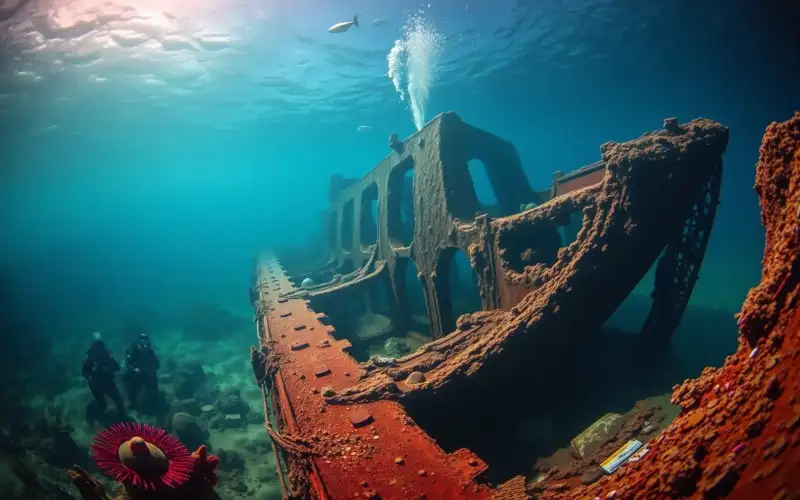
Drop deeper, and you reach the vehicle decks. This is where the trucks sit, frozen in the moment of sinking. Some are upright. Some have shifted. Many are completely encrusted with corals and anemones. The cabs are homes to fish. You can see inside the windows. The steering wheels are still visible under the coral growth.
The cargo hatches hang open at this depth. This is where penetration dives begin. Your guide ties off a line, and you follow it into the dark. Visibility drops. Your torch becomes your world. The passage narrows. You're swimming through a ship—past cargo, past machinery, past the skeletal remains of the ship's systems. It's overwhelming the first time. It's addictive every time after.
The Engine Room (40–50 metres)
The engine room is the holy grail for intermediate and advanced divers. It sits deep—40 to 50 metres depending on which section you're exploring. The main engines are enormous, green with corals. The propeller shaft runs aft. Pipes and valves hang like the organs of some great steel beast. The air space in the upper engine room—yes, there's a pocket of air trapped inside the wreck—is accessible to advanced divers who've done the training.
Diving the engine room requires technical training. The passage is narrow. The depth is significant. Nitrogen narcosis is real. But divers who've done it describe it as transformative. You're inside a ship. You're inside history. You're 50 metres down and breathing air from a tank, and somehow it feels like the most natural thing in the world.
The Stern Section and Deeper Passages (45–55 metres)
Advanced technical divers push aft to the stern section and the deepest passages. The visibility here is often poor—silty, dark, demanding powerful torches and absolute confidence in buoyancy control. The passages are maze-like. Without a guide or extensive previous experience, you could easily become disoriented.
The reward is solitude and depth. You're among the few divers who'll ever see these sections. The truck cabs here are almost completely covered in coral. The superstructure is less visited, less disturbed. It feels like genuine exploration, not tourism.
Choosing a Dive School in Larnaca
What to Look For
Not all Larnaca dive schools are equal. Some are PADI 5-Star IDC Centres with full training facilities and experienced technical instructors. Others are small operations with one or two guides. Both can deliver safe dives, but they offer different experiences.
Look for schools that are PADI-affiliated, have current insurance, employ dive masters with 500+ logged dives, and operate boats with GPS, radio, and oxygen on board. Ask for references. Ask to speak with divers who've used the school. A good dive school will encourage this. A sketchy one will pressure you to book immediately.
Prices vary. Single recreational dives cost £60–90. Wreck specialty courses run £400–600. Technical wreck courses reach £1,500–2,000. Budget accordingly. The cheapest option isn't always the best. A school that charges £70 for a Zenobia dive might cut corners on safety briefings or equipment maintenance. A school that charges £85 might invest in better boats, more experienced guides, and smaller group sizes.
Key Questions to Ask Before Booking
- How many divers per guide? (Answer should be 4 or fewer for Zenobia dives.)
- What's your boat's safety equipment? (GPS, radio, oxygen, first aid kit, defibrillator.)
- What's your guide's experience on the Zenobia specifically? (Look for 100+ dives on this wreck.)
- Do you provide weights and tanks, or should I bring my own? (Either is fine, but confirm in advance.)
- What's your cancellation policy if weather turns bad?
- Do you offer nitrox fills? (Many schools do; it extends your bottom time on deeper dives.)
Recommended Schools (2026)
Based on personal experience and diver feedback, these schools consistently deliver safe, professional Zenobia dives:
Dive In Cyprus (Larnaca harbour front): PADI 5-Star facility, 25+ years operating, excellent technical training, small groups, €80–90 per dive, wreck courses €500.
Poseidon Diving Center (near Larnaca Marina): Family-run, PADI certified, strong reputation for wreck diving, €75–85 per dive, good equipment maintenance.
Aquanaut Diving School (Larnaca): Long-established, technical diving specialists, comprehensive training, €85–95 per dive, €1,500+ technical courses.
All three schools are reachable by 10-minute taxi from Larnaca Airport. Book direct through their websites or by email. Expect to pay deposits (30–50%) to secure dates, especially in summer.
Preparing for Your Zenobia Dive
Physical Fitness and Health
Wreck diving is more physically demanding than reef diving. You'll be wearing full equipment, descending and ascending a shot line, maintaining precise buoyancy in a confined space, and managing your air consumption under stress. You need to be reasonably fit. You don't need to be an athlete, but you should be able to climb stairs without breathlessness and carry your dive gear without strain.
If you have any medical conditions—heart problems, ear issues, asthma, diabetes—disclose them to your dive school before booking. Some conditions are incompatible with diving. Others require medical clearance. Dive schools will ask you to complete a medical form. Answer honestly. A school that doesn't ask medical questions isn't following proper safety protocols.
Equipment Checklist
Most dive schools provide tanks, weights, and BCDs. Some divers prefer their own gear. If you're bringing gear from the UK, pack it carefully in checked luggage. Airlines charge £30–50 for dive equipment. Confirm your school's policies before packing.
Essential items to bring or hire:
- Wetsuit (5mm for summer, 7mm for winter; schools hire for £5–10)
- Mask, fins, snorkel (bring your own if you have a favourite fit)
- Dive computer (critical for safety; rent for £15–20 per day)
- Dive torch (for wreck penetrations; schools provide, or bring your own)
- Underwater notepad (useful for communicating with your guide)
- Medications (bring from home; Cypriot pharmacies stock basics but not everything)
Pre-Dive Briefing and Safety
A proper Zenobia dive begins 2–3 hours before you enter the water. Your dive school will conduct a detailed briefing: the weather forecast, sea conditions, the planned dive profile, entry and exit procedures, emergency protocols, and specific hazards on the Zenobia.
Listen carefully. Take notes. Ask questions. If something doesn't make sense, speak up. Your guide should be patient and clear. If a guide seems rushed or irritated by questions, reconsider whether you want to dive with them.
On the boat, your guide will confirm your certifications, review your dive computer settings, and check your equipment. They'll ask about your experience on wreck dives and your comfort level at depth. They'll assign you a buddy. They'll brief you on the specific penetration route if you're doing a wreck dive. Then, when conditions are right, you'll enter the water.
The Zenobia Experience: What Divers Report
I ask every diver I guide what they'll remember most about the Zenobia. The answers vary. Some talk about the moment they first saw the bridge emerge below. Some describe the shock of swimming inside the ship, surrounded by steel and darkness. Some mention the trucks, sitting on the deck like they'd been parked there yesterday. Some talk about the silence—the absence of the ship's engines, the absence of life, the presence of time.
One diver, a retired schoolteacher from Bristol, told me:
Comments (4 comments)