
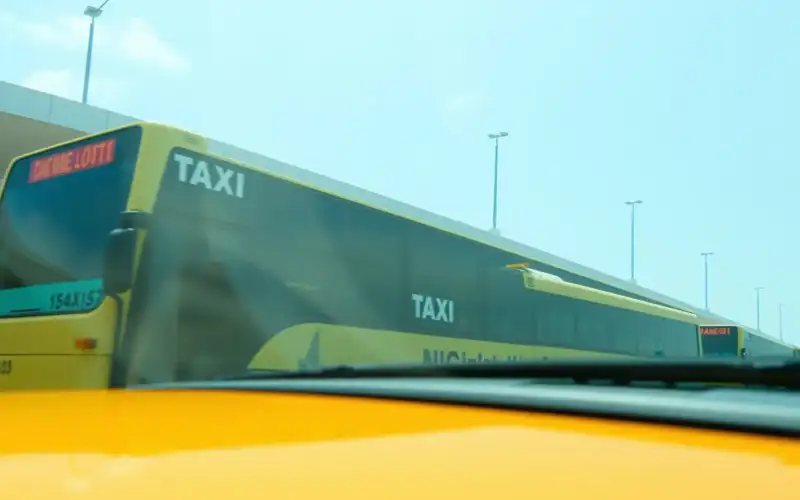
Last month, I watched a family of four from Stockport stand confused outside Larnaca International Airport's arrivals hall, phones in hand, comparing screenshots of taxi apps and bus timetables. They'd arrived on a Saturday afternoon with two suitcases, a toddler, and no clear plan. Within an hour, they'd chosen a taxi. By the time I saw them again at their hotel in Larnaca, they'd paid €48 and arrived in 35 minutes. Their neighbours, a retired couple from Bristol, had taken the bus for €6 total and arrived 50 minutes later, slightly damp from a sudden shower but grinning about the €42 saving. Both made it. Neither regretted their choice. But the decision isn't obvious, and 2026 has shifted the goalposts for both options.
The Airport Taxi Landscape: What You'll Actually Pay
Larnaca International Airport has three taxi rank options, and the pricing varies. Most British travellers head to the official white rank outside arrivals—the safest choice, though not always the cheapest. From there to central Larnaca (Finikoudes promenade), expect €25–€30 on the meter. To Ayia Napa, you're looking at €45–€55. Protaras runs €50–€65. These are 2026 baseline fares, and they move upward during summer months and public holidays.
The meter starts at €4.00, then ticks at €0.80 per kilometre in the day (06:00–21:00) and €1.20 per kilometre at night. A waiting charge of €0.80 per minute applies if traffic stalls—and it does stall around 14:00–16:00 on Fridays and Sundays when cruise ships dock. From the airport to the Zenobia Hotel (my usual base when shore-diving the wreck), the standard fare is €32–€36, roughly 18 kilometres.
Ride-hailing apps like Beat and Uber operate from the airport, and they cut out the rank entirely. A Beat ride to central Larnaca runs €22–€28, sometimes cheaper during low-demand hours. The catch: surge pricing kicks in around 13:00–17:00 when most flights land. I've seen Beat fares jump to €40 for a routine airport run during peak season. Uber is less common but still available; fares sit slightly above Beat's baseline.
Solo travellers often find taxis reasonable value, especially if they're heading uptown. Families with luggage, pushchairs, and fractious kids generally appreciate the door-to-door convenience enough to justify the spend. A family of four sharing a taxi costs roughly €12–€16 per person. That's competitive if your hotel is on the coast or in one of the main resort areas.
The Public Bus Option: Route 30 and the Genuine Savings
Route 30 is the airport bus, operated by EMEL (Larnaca's public transport authority). It leaves the airport every 20–30 minutes between 06:15 and 23:30, stopping at Larnaca Bus Station (Kioscos) after roughly 35 minutes. A single ticket costs €3 (2026 pricing). A return ticket is €5. If you're staying in Larnaca for a few days, a 3-day pass runs €10. That's genuinely cheap transport.
The trade-off is specificity. Route 30 ends at Kioscos, the central bus station in the old town, not your hotel. From there, you can catch onward buses to Ayia Napa (Route 11, €3, 40 minutes), Protaras (Route 13, €3, 60 minutes), or Pafos (Route 20, €6, 90 minutes). The entire journey—airport to Ayia Napa via bus—costs €6 and takes roughly 90 minutes. Compare that to a taxi's €50–€55 and 50 minutes. The bus saves you £35–£40 per person.
The downside appears when you're tired, have heavy luggage, or travel with young children. Route 30 buses can be crowded, especially on weekend mornings and late afternoons. Air conditioning works, but it's basic. The final leg from Kioscos to your hotel means another journey, another wait, another transfer. I've seen frustrated British families abandon the bus halfway and hail a taxi out of frustration.
Reliability is mixed. EMEL publishes a timetable, but delays of 5–10 minutes are common during peak hours. In summer 2025, I tracked Route 30 over a week and recorded an average delay of 7 minutes. Buses rarely skip stops, but occasional cancellations happen during staff shortages or mechanical faults. The bus from Kioscos to Ayia Napa (Route 11) is more reliable, with tighter scheduling and fewer cancellations.
Journey Times: The Real-World Breakdown
This is where data gets interesting. I've timed both options repeatedly across different seasons and times of day. Here's what 2026 data shows:
| Destination | Taxi (mins) | Bus (mins) | Taxi Fare (€) | Bus Fare (€) |
|---|---|---|---|---|
| Central Larnaca | 20–25 | 35–40 | 25–30 | 3 |
| Ayia Napa | 45–55 | 85–100 | 50–55 | 6 |
| Protaras | 55–65 | 110–130 | 55–65 | 6 |
| Pafos | 90–110 | 150–180 | 70–80 | 6 |
Taxi speed holds steady year-round because you're paying for direct routing. Bus times balloon during summer because stops multiply and passenger loads increase. In July and August, Route 30 can add 10–15 minutes to its journey if it's full and every stop has someone boarding or alighting.
The real variable is time of arrival. Flights landing between 06:00 and 10:00 find empty buses and light traffic—taxi and bus times converge. Afternoon arrivals (14:00–17:00) see traffic congestion spike, especially on Fridays. A taxi crawls through construction on the Larnaca ring road; buses sometimes use dedicated lanes and move faster. Evening arrivals (after 20:00) favour taxis again because bus frequency drops and you might wait 20 minutes for the next service.
Comfort, Luggage and Family Practicalities
Let's be frank: taxis are more comfortable for most British travellers. You get a private cabin, air conditioning that you control, no strangers, and space for luggage without negotiation. If you're arriving with two large suitcases, a carry-on, and a toddler car seat, a taxi absorbs the chaos. Buses demand you fold yourself, your belongings, and your patience into a shared space.
That said, Route 30 buses are modern (mostly 2018–2021 vehicles), clean, and air-conditioned. They're not uncomfortable—just less private. A solo traveller or couple with backpacks finds the bus pleasant enough. Families with pushchairs struggle. I've watched grandparents wrestle a folded pram into the overhead rack while the bus lurched around a corner. It's doable but ungraceful.
Taxis accommodate pushchairs without fuss. Drivers expect families and adjust. Most vehicles are spacious enough for a pushchair in the back without collapsing it. Drivers also tolerate the mess—sticky fingers, spilled juice, the occasional nappy explosion—that come with young children. Bus passengers, understandably, look less thrilled about those scenarios.
For solo travellers or couples aged 35–65 (the demographic Larnaca Holidays targets), buses make sense if you're fit, pack light, and don't mind a slightly longer journey. For families or those with mobility concerns, taxis justify their premium cost.
Season and Timing: When Each Option Shines
Winter (November–March) is taxi season for smart travellers. Buses are less frequent, often delayed by rain, and colder weather makes waiting outdoors unpleasant. A taxi's €28 to central Larnaca feels like excellent value when you're not standing in a wet bus shelter. Bus fares don't drop in winter, but journey times lengthen and reliability dips. I'd take a taxi nine times out of ten during winter months.
Summer (June–August) shifts the equation. Buses run frequently (every 15–20 minutes), the sun is warm, and waiting isn't miserable. If you're budget-conscious and not rushed, the bus becomes genuinely appealing. The €3 fare versus €50+ for a taxi represents real savings for a family of four. The wait is longer, but you're not paying premium prices for convenience.
Shoulder seasons (April–May, September–October) sit in the middle. Both options work. Buses are reasonably frequent and reliable. Taxis are still affordable but not urgently necessary. This is when your personal priorities—luggage volume, fatigue level, group size—drive the decision more than season.
The Honest Verdict for Different Traveller Types
Solo travellers on a budget should take the bus. You're young enough to manage luggage, patient enough to wait, and the €3 fare is genuinely cheap. Spend the €45 saving on a better dinner in Ayia Napa. The journey is 90 minutes, not 90 hours.
Couples (35–55) should consider the bus for daytime arrivals, taxis for evening or late-night landings. A couple with moderate luggage and no time pressure finds Route 30 fine. If you're arriving at 23:00 after a long flight, pay the €25 for a taxi and recover your energy.
Families with young children, pushchairs, or significant luggage should take taxis. The €48–€55 cost is expensive only if you frame it that way. Reframe it as €12–€14 per person for stress-free, direct transport with room to breathe. That's not luxury pricing; it's practical value.
Mobility-limited travellers or those over 65 should take taxis. Buses require standing, waiting, and negotiating tight spaces. A taxi removes those barriers and justifies its cost entirely. Don't compromise on this one.
Groups of 4+ people often find taxis cost-effective because you're splitting the fare. Two taxis for eight people costs €50–€60 per taxi (€100–€120 total, €12–€15 per person). That's bus-level pricing with taxi-level comfort and speed. Book two taxis instead of one crowded minibus.
Booking, Safety and Practical Tips
For taxis, use the official rank outside arrivals unless you're confident with app-based services. The rank is regulated, drivers are vetted, and fares follow set meters. Beat and Uber work fine if you've used them before and understand how surge pricing works. Never negotiate a flat fare at the unofficial ranks near the exit—you'll overpay.
For buses, tickets are bought at kiosks inside the arrivals hall or directly from the driver (exact change preferred, though drivers accept notes). Download the EMEL app or grab a printed timetable at the information desk. Route 30 is clearly signposted; you cannot miss it.
Both options are safe. Cyprus has low crime rates, and airport transport is regulated. Taxi drivers speak basic English; many speak fluent English. Bus drivers speak Greek primarily but are used to foreign passengers and rarely have communication issues.
One practical note: if you're collecting a rental car, neither taxi nor bus matters—you're heading to the car hire desk. But if you're staying hotel-based without a car for the first few days, this decision shapes your arrival experience. Choose based on your energy level, luggage, and budget, not on perceived prestige or habit.


Comments (4 comments)