
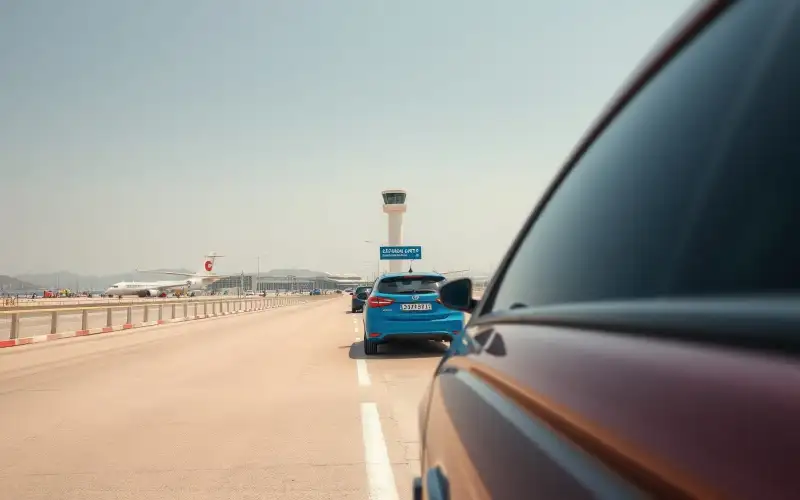
The Airport Pickup Reality: What to Expect on Arrival
You've just touched down at Larnaca Airport after five hours from London. The baggage carousel spits out your luggage. You're thinking about that taverna in Lefkara you've booked for lunch. But first: the car hire desk. And here's where most British travellers make their first mistake.
The car rental counters at LCA sit in the arrivals hall, clustered together like a competition. Hertz, Europcar, Budget, Avis, and half a dozen local firms all flash their logos. The temptation is to grab the first desk with a short queue. Don't. That queue might be short because they're about to hit you with a €45 excess waiver charge you didn't budget for, or because their insurance excess is €1,500 instead of €500.
Arrival times matter. If you land at 6 p.m. in July, you're queuing with 200 other passengers. If you land at 10 a.m. in April, you might be done in ten minutes. The counter staff move faster when they're not drowning, and you get time to actually read the contract instead of signing blind while sweating in the air-conditioning.
Documents You Actually Need
Bring your UK driving licence—the photocard version, not the old paper one. Bring your passport. Bring your credit card; every hire company requires one for a deposit hold, usually €500–€800, released when you return the car undamaged. Bring an International Driving Permit if you're feeling cautious, though your UK licence is technically valid for visitors. Bring your proof of address (utility bill, council tax letter—emailed to your phone counts). Most firms won't ask for it, but some will, and it's easier to have it than to argue.
Your travel insurance or breakdown cover might include car hire excess waiver. Check your documents before you arrive. If you've got it in writing, you can often decline the rental company's expensive waiver and save €10–€20 per day.
The Major Players: Who's Renting at LCA in 2026
Hertz
Hertz dominates LCA, with the biggest desk and the most cars. A basic three-door Hyundai i10 or Toyota Aygo runs about €25–€35 per day in shoulder season (April–May, September–October), jumping to €45–€60 in peak summer (July–August). Winter rates (November–February) drop to €18–€28. These are walk-up prices; book online two weeks ahead and you'll often knock 20% off.
Hertz's insurance options are straightforward but pricey. Their standard excess is €750; the reduction to €250 costs about €12–€15 per day. Full cover (zero excess) runs €18–€22 per day but requires a deposit card hold. Staff are efficient, though the queue can be long. I've hired from them four times in three years and never had a claim issue, though their cars occasionally show the wear of the Cyprus heat.
Europcar
Europcar's fleet is newer than Hertz, with a decent selection of compact SUVs (Peugeot 2008, Citroen C3 Aircross) alongside the standard hatchbacks. Pricing is similar: €28–€40 shoulder season, €50–€65 peak summer. They're slightly cheaper on insurance excess reduction (€10–€12 per day for excess down to €250). Their website often shows promotional rates if you book a week in advance.
One quirk: Europcar charges a €50 return fee if you bring the car back after 8 p.m. or on a Sunday. Check your drop-off time before committing. They have a satellite desk at Larnaca Marina, useful if you're dropping off in town rather than returning to the airport.
Budget and Avis
Budget (owned by Avis) offers the cheapest headline rates—sometimes €20–€30 per day in winter—but read the fine print. Their excess is often higher (€1,000), and add-ons stack up quickly. Full insurance can push an apparent €20 day rate to €35 once you factor in mandatory extras. Avis runs a more premium operation, with better cars and higher prices (€35–€50 baseline). Both have airport desks, but neither has the scale of Hertz or Europcar.
Local Firms: Thrifty Cyprus, Sixt, Oscar
Local operators like Thrifty Cyprus and Oscar offer competitive rates, sometimes 10–15% cheaper than the big brands. Thrifty's customer service is solid; Oscar's fleet is older but reliable. Sixt (German brand, but operates locally) sits in the middle on price and quality. The gamble with smaller firms is resale value if you have a problem—a small dent that Hertz would ignore might trigger a €300 claim from Oscar. For a one-week rental of a basic car, a local firm might save you €40–€60. For a fortnight or if you value the safety net of a global brand, stick with Hertz or Europcar.
Insurance: Where Renters Get Stung
Insurance is where car hire companies make real money, and where British travellers often overpay. Let's break down the options you'll face at the counter.
The Standard Offer
The company presents a base rental with an excess (deductible) of €750–€1,000. Any damage—a wing mirror, a scratch, a chip in the windscreen—comes out of that, or out of your pocket if you caused it. This is effectively no insurance; it's your risk. They then offer collision damage waiver (CDW) and theft protection, which reduces your excess to €250–€500. This usually costs €12–€18 per day for a small car, €18–€25 for an SUV.
The next level is


Comments (4 comments)