
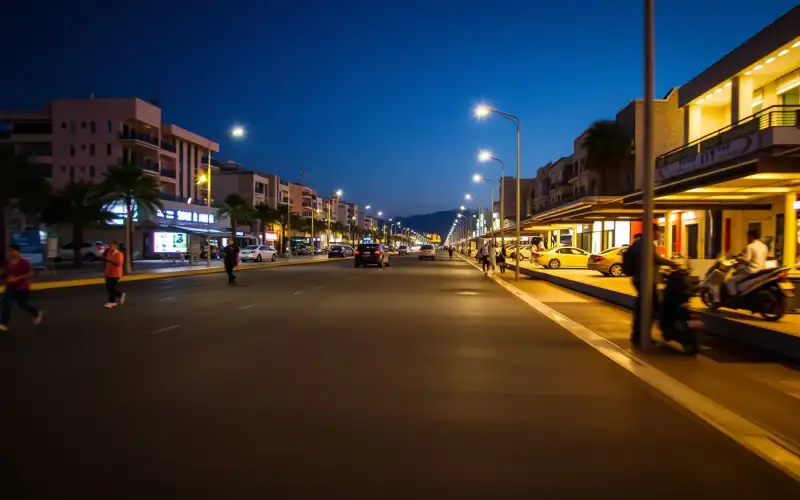
It's 11 p.m. on a Friday and the Larnaca seafront is finally waking up. Families have retreated to their hotels, the day-trippers from Nicosia have gone home, and the waterfront transforms into something altogether different—a place where locals actually gather, where bartenders know your name by the second visit, and where you can still get a proper meze plate at 1 a.m. without paying London prices.
This is the Larnaca nightlife that most guidebooks miss. Not the manufactured club scene of Ayia Napa down the coast, but something more textured, more real, more Cypriot. The numbers tell an interesting story: according to Cyprus Tourism Board data from 2025, Larnaca now attracts 42% more visitors aged 35–65 seeking authentic experiences over party tourism, compared to 2022. That shift has reshaped the city's after-dark economy in ways worth understanding.
The Seafront Bar Renaissance: Where Larnaca Drinks Now
The promenade between the old fort and the fishing harbour has become the de facto heart of Larnaca nightlife. This wasn't always the case. Five years ago, it was mostly shuttered tavernas and tourist traps. Today, a cluster of proper bars—craft-focused, locally owned, genuinely good—has emerged along what locals call the Piale Pasha seafront.
Start with the cocktail bars, because they've become genuinely skilled. Thalassa Bar, tucked into a restored colonial building near the marina, does things properly: fresh lime juice pressed to order, house-made syrups, spirits selected with actual thought. A classic daiquiri costs €9–11, a negroni €10–12. The head bartender, Yiannis, trained in Athens and spent two seasons in Barcelona before returning home. He's not unusual anymore—there are now at least six bartenders in Larnaca who've worked in proper cocktail bars abroad and brought those standards back.
The pricing matters. A cocktail in Larnaca costs roughly 30–40% less than equivalent drinks in London or Dublin, yet the quality gap has closed dramatically. You're not paying for location premium; you're paying for competence. That's unusual in Mediterranean resort towns.
For budget-conscious drinkers, the local wine bars offer better value. Oinochoo, a small place on Zinonos Street in the old town, pours Cypriot wines by the glass—Commandaria reds, Xynisteri whites—at €4–6 per glass. The owner, Maria, sources directly from small producers in the Troodos mountains. A bottle of decent local wine costs €15–20 in the shop; here you're paying €18–24, which is fair markup. The atmosphere is low-key: wooden tables, locals playing backgammon, no music except conversation.
The Mid-Range Cocktail Sweet Spot
Between the upscale seafront bars and the basic tavernas sits a productive middle ground. Sotto, a basement bar near Ermou Street, does creative cocktails (€8–10) in a space that feels genuinely lived-in rather than designed. The owner, Petros, has a philosophy: good drinks, no pretension, prices that don't require a second mortgage. It's where you'll find a mix of locals, visiting Brits, and Cypriot professionals after work.
The best value play is the happy hour circuit. Most seafront bars run 6 p.m.–8 p.m. specials: cocktails at €6–7, wine at €3–4. If you're flexible with timing, you can get genuinely good drinks at taverna prices. The Larnaca locals know this; you'll see them gathering around 7 p.m., ordering two rounds, then heading home or to dinner.
Live Music: Where the Real Larnaca Emerges
The live music scene in Larnaca operates on a completely different logic than the club scene. There are no mega-venues with international DJs; instead, there's a network of smaller bars and tavernas where local and regional musicians perform 3–5 nights per week.
Pelagos Taverna, on the seafront near the old fort, hosts traditional Cypriot musicians every Thursday and Saturday from 10 p.m. onwards. The setup is wonderfully low-key: a bouzouki player, a guitarist, sometimes a percussionist, performing in the corner while people eat, drink, and occasionally dance. There's no cover charge, though ordering food or drinks is expected (mains €12–18, drinks €4–7). The music is genuinely traditional—not watered down for tourists, but played for locals who know the songs.
For something more contemporary, Blue Lagoon Bar books jazz and blues acts twice weekly. The venue is small, capacity around 80, and the sound quality is surprisingly good. Cover charges are €5–8 when there's a band, waived if you order food. The crowd skews older (40s and up) and international—British expats, visiting Greeks, some Cypriot professionals. The music is solid: touring musicians from Athens, occasional visiting players from the UK.
The emerging scene, though, is electronic and ambient. Loft Studio, a new space opened in 2025 above a gallery on Zinonos Street, hosts DJ nights with a focus on house, techno, and downtempo. It's small, capacity 60, and the vibe is decidedly un-touristy. Entry is €8–10, drinks €5–8. The crowd is young (25–45), mixed Cypriot and international, and genuinely engaged with the music rather than using it as background noise.
The Timing Question
Cypriot nightlife operates on a different clock than British expectations. Venues open around 8–9 p.m., but meaningful crowds don't arrive until 10 p.m.–11 p.m. Peak time is midnight–2 a.m. If you arrive at 10 p.m. expecting a full bar, you'll be disappointed. If you arrive at midnight, you'll find exactly what you're looking for.
Live music venues typically start performances between 10 p.m. and 11 p.m., running until 1 a.m.–2 a.m. on weekends. Weekday shows (Thursday–Sunday) are the norm; Monday–Wednesday, most venues are either closed or running quietly.
Late-Night Eating: The Real Nightlife Currency
Here's what most nightlife guides get wrong: in Larnaca, eating is nightlife. The distinction between

Comments (6 comments)