
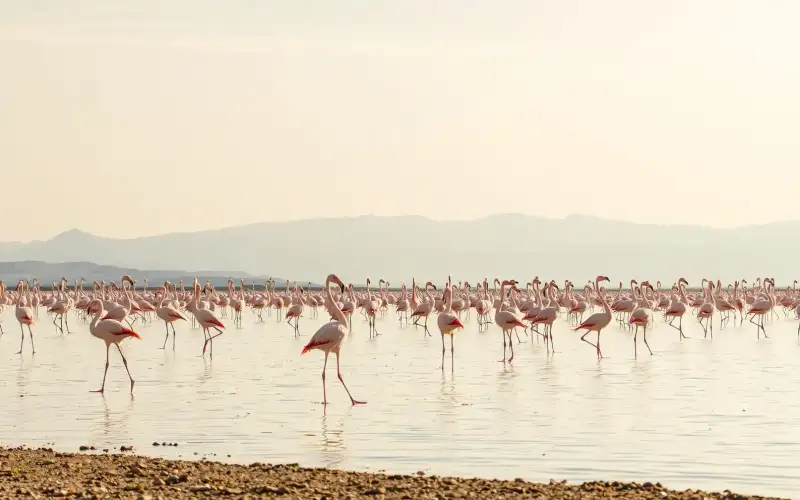
On a grey Tuesday morning in January, I drove the airport perimeter road past the threshold of Runway 04 and nearly rear-ended the car in front. The driver had stopped, window down, staring. The entire southern basin of Larnaca Salt Lake — roughly 2.5 square kilometres of shallow brine — had turned the colour of a flamingo's wing. Several thousand birds, packed so tightly the water had disappeared beneath them. It takes you by surprise every single time, even when you know it's coming.
That scene repeats itself every winter between late October and late March. Yet a surprising number of British visitors fly in and out of Larnaca Airport without realising the lake is literally on the airport boundary — viewable from the taxi queue if you know where to look. This guide is about fixing that oversight.
Why Larnaca Salt Lake Matters for Flamingos
The lake is a hypersaline lagoon sitting at sea level, fed by winter rains and sealed off from the Mediterranean by a narrow sand barrier. In summer it dries to a white salt crust — the source of Venice's salt trade for centuries. Come October, the rains return, the basin floods, and so do the birds.
Greater flamingos (Phoenicopterus roseus) use Cyprus as a mid-migration staging post on the route between the Aegean and North Africa. Larnaca Salt Lake is one of the largest wintering sites in the eastern Mediterranean, regularly hosting between 8,000 and 12,000 birds in peak season. The 2025–2026 winter count conducted by BirdLife Cyprus in December 2025 recorded just over 10,400 individuals — a strong showing by any measure.
What makes the lake unusual is its proximity to an international airport. The birds are entirely habituated to aircraft noise. A Boeing 737 on short final passes 400 metres overhead and the flock doesn't flinch. It's a genuinely strange spectacle — pink birds, jet engines, minaret in the background.
When to Go: The Winter Window
Timing is everything. The flamingos are not present year-round.
| Month | Flamingo Presence | Typical Numbers | Weather |
|---|---|---|---|
| October | Arriving, patchy | 500–2,000 | Warm, 24–27°C |
| November | Building | 2,000–6,000 | Mild, 19–23°C |
| December | Strong | 6,000–10,000 | Cool, 16–20°C, some rain |
| January | Peak | 8,000–12,000 | Cool, 14–18°C, occasional rain |
| February | Peak to declining | 6,000–10,000 | 15–18°C, improving |
| March | Departing | 1,000–4,000 | 18–22°C, mostly dry |
| April onward | Absent | 0 | Warming rapidly |
January is the banker month. If you're planning a trip specifically around the flamingos, target mid-January to mid-February 2026. The birds are at maximum density, the light in the mornings is low and warm, and the tourist crowds are minimal. Larnaca in January is a genuinely quiet place — hotels cut their rates significantly, the Finikoudes promenade belongs to locals and dog-walkers, and you can get a table at any restaurant without a booking.
For photographers, the golden hour window runs roughly 07:15 to 08:30 in January. The sun rises behind the Troodos foothills to the west of the lake, casting warm light across the water and the birds. Arrive before 07:30 to get position.
The Three Best Viewpoints
1. The Airport Perimeter Road (Mackenzie Side)
The most accessible viewpoint requires no walking at all. The road running south from Mackenzie Beach past the end of the runway — locally called the airport perimeter road — runs along the northern edge of the lake. There's an informal pull-off area near the old salt warehouses where you can park and scan the entire northern basin. Distance to the nearest birds is typically 150–400 metres depending on where the flock is feeding. Binoculars are useful; a 300mm lens will get you frame-filling shots.
This is also the viewpoint you'll see from the taxi if you're being driven into town from the airport. Ask the driver to slow down for 30 seconds — most are happy to oblige.
2. The Hala Sultan Tekke Causeway
A raised earthen causeway crosses the lake from the western shore to the mosque of Hala Sultan Tekke, roughly 800 metres long. Walking it puts you at water level, surrounded by the lake on both sides. When the flamingos are feeding in the western basin — which they frequently are in January — you can find yourself within 80–100 metres of the nearest birds. This is the closest you'll get without disturbing them.
The causeway is unpaved and uneven in places. After rain it can be muddy. Wear shoes with grip, not sandals. The walk from the mosque car park to the end of the causeway and back takes about 25 minutes at a gentle pace.
3. The Southern Shore Track
A dirt track runs along the southern edge of the lake from the village of Dromolaxia, accessible via the B4 road. It's less visited than the other two viewpoints, which means less disturbance and occasionally better bird positioning. The track is passable in a standard hire car in dry weather; after heavy rain, leave it to 4x4s. Park near the junction with the Dromolaxia–Meneou road and walk east. You'll cover about 1.2 kilometres before the track becomes overgrown.
Combining the Lake with Hala Sultan Tekke
The mosque of Hala Sultan Tekke sits on the western shore of the lake, surrounded by date palms and oleander, and is one of the most important Islamic pilgrimage sites in the Middle East. It's also free to enter, open daily from 08:00 to 18:00 (summer hours extend to 20:00), and takes about 20 minutes to visit properly.
The combination of flamingo-watching on the causeway followed by a visit to the mosque is the most satisfying morning itinerary in the Larnaca area. Here's how I'd structure it:
- Arrive at the Hala Sultan Tekke car park by 07:30. The car park is signposted off the B4 road, about 4 kilometres west of Larnaca town centre.
- Walk the causeway immediately — the light is best and the birds are active before 09:00.
- Return to the mosque for a 20-minute visit. Remove shoes at the entrance; a headscarf is available if needed.
- Drive or walk 10 minutes back toward Mackenzie for breakfast. The Mackenzie Beach strip has several cafés open from 08:00, including a branch of Costa and a handful of local spots serving halloumi omelettes.
Total time from arrival to breakfast: around two hours. It's a compact, rewarding morning that costs nothing except parking (free) and coffee.
The mosque garden in January is completely still. Cats sleep on the stone walls. The lake glitters through the palm fronds. I've taken guests there a dozen times and nobody has ever been disappointed — even the ones who came for the flamingos and weren't particularly interested in Ottoman architecture.
What to Wear and Bring
British visitors consistently underestimate Cypriot winters. Larnaca in January is not cold by UK standards — daytime highs of 16–18°C are typical — but the mornings at the lake are damp and the wind off the water has an edge to it. You're standing still, looking at birds. You'll feel it.
- Layers: A fleece mid-layer and a light windproof shell is the right combination. Leave the heavy winter coat at home.
- Footwear: Trainers or walking shoes with grip for the causeway. The perimeter road viewpoint is tarmac, so anything goes there.
- Binoculars: 8x42 or 10x42 is the standard birdwatching specification. Even a cheap pair from Argos transforms the experience. The birds are not always close.
- Camera: If you're serious about photography, 400mm equivalent focal length is the minimum for frame-filling shots. A 70–300mm zoom on a crop-sensor camera will do the job at the causeway viewpoint.
- Water and snacks: There are no facilities at the lake itself. Bring a bottle. The mosque has a tap in the courtyard.
Practical Logistics from Larnaca Airport
The lake is 2.5 kilometres from the terminal building. That's the single most useful fact in this guide. If you're arriving on an early morning flight — the first Ryanair service from Stansted typically touches down around 06:50 — you could theoretically be at the causeway viewpoint by 07:30 with a hire car collected from the terminal forecourt.
Hire car desks at Larnaca Airport are in the arrivals hall ground floor. The major operators — Europcar, Hertz, Budget, Sixt — all have desks there. Expect to pay £18–£28 per day for a compact car in January 2026, booked in advance online. The drive to the Hala Sultan Tekke car park from the terminal is 8 minutes via the B4.
If you're not hiring a car, Bus Route 425 runs from Larnaca bus station (Finikoudes) to the Hala Sultan Tekke junction, roughly every 40 minutes during daylight hours. The journey takes about 15 minutes and costs €1.50. From the bus stop it's a 600-metre walk to the mosque and causeway. Check the Intercity Buses Cyprus website for the 2026 timetable before you travel — services have been adjusted in recent years.
I've met passengers who've done a two-hour flamingo visit between a morning arrival and a hotel check-in at noon. It works perfectly. The lake is not a detour — it's on the way into town.
Where to Stay Nearby
If you want to make the flamingo visit the centrepiece of a short winter break rather than a quick stop, there are several hotels within easy reach of the lake.
The Palm Beach Hotel on the Larnaca–Dhekelia road is the closest full-service hotel to the lake, about 3 kilometres from the Hala Sultan Tekke car park. It's a four-star property with a decent pool and direct beach access — rates in January 2026 start around £65 per night for a double room, bed and breakfast. Not glamorous, but solid and convenient.
In town, the Radisson Blu Larnaca on Finikoudes is the most polished option at the upper end of the mid-range bracket — expect £90–£120 per night in January. The location on the seafront promenade is excellent and the breakfast buffet is substantial. From here, the drive to the lake is 10 minutes.
Budget travellers should look at the Larco Hotel near the old harbour, which offers clean, no-frills rooms from around £40 per night in winter. It's a 15-minute drive to the lake but walking distance to the Turkish quarter, the Kamares aqueduct, and the best meze restaurants in town.
A Note on Responsible Watching
Flamingos are large, conspicuous birds, but they're also easily disturbed when feeding. A few practical rules that BirdLife Cyprus recommends:
- Stay on the causeway or the marked paths. Don't wade into the lake margins or cut across the salt flat.
- Keep noise down, particularly in groups. The birds tolerate aircraft but not shouting humans at close range.
- Dogs should be kept on leads at all times near the lake edge.
- If the nearest birds start moving away from you, you're too close. Back off 20 metres and wait — they'll often return.
The lake is a Special Protection Area under EU Birds Directive legislation. Cyprus has maintained that designation post-Brexit through its own environmental legislation, and the site is actively managed by the Cyprus Department of Environment. Disturbance to protected species carries a fine of up to €3,000 under Cypriot law.
None of this should put you off. The vast majority of visitors watch from the causeway or the perimeter road, at a perfectly respectful distance, and have a genuinely memorable experience. Ten thousand pink birds on a winter morning, with a 737 on approach overhead and a sixteenth-century mosque in the palm trees behind you — it's not something you'll forget in a hurry.
Comments (7 comments)